
Shoes sold online are often described as OEM shoes, factory shoes, replicas, or original shoes, but these terms do not mean the same thing. This confusion can make it difficult for buyers and footwear brands to understand what they are actually purchasing or producing. So, what is the OEM meaning in shoes? In this guide, we explain how OEM footwear manufacturing works, what it means for product quality and authenticity, and what brands should know before choosing an OEM manufacturing partner.
What are OEM Shoes: Meaning
OEM stands for Original Equipment Manufacturer. In footwear, OEM shoes are products manufactured by a third-party factory according to the designs, specifications, materials, branding requirements, and quality standards provided or approved by another company. In simple terms, the brand develops or controls the product requirements, while the OEM factory is responsible for turning those requirements into finished footwear. This follows the broader OEM model, in which a customer contracts a manufacturer to produce goods according to specified requirements.
For the footwear brand, this arrangement makes it possible to launch products without owning and operating an entire shoe factory. The brand can focus on product development, branding, marketing, distribution, and sales while working with an experienced manufacturer for production. Depending on the agreement, the brand may provide a complete tech pack and material specifications or work with the supplier to refine certain production details.
For the OEM factory, the role is mainly to provide the manufacturing resources needed to produce the shoe at the required scale and quality. This may include material sourcing, pattern preparation, cutting, stitching, lasting, sole attachment, finishing, quality inspection, and packaging. The exact scope varies between manufacturers, so brands should confirm which development and production services are included before placing an order.
OEM footwear manufacturing is especially common across Asia. China, Vietnam, Indonesia, and other Asian manufacturing markets have developed substantial garment and footwear supply chains serving international buyers.
The OEM model is also not limited to one type of shoe. Depending on the factory’s specialization and equipment, OEM production can cover sneakers, casual shoes, leather shoes, sandals, boots, athletic footwear, work shoes, and other footwear categories.
OEM vs Original Shoes: What are the Differences?
The terms OEM shoes and original shoes are often compared as if they describe two different product types, but they actually refer to different things. OEM describes how a shoe is manufactured, while “original” usually refers to whether the product is authentic and authorized by the brand.
For example, a footwear brand may design a shoe, set the material and performance requirements, provide its logo and specifications, and then hire an independent factory to manufacture it. In this case, the finished product can still be an original branded shoe even though it was made under an OEM arrangement. The factory does not need to be owned by the brand for the footwear to be genuine.
This is why OEM brand shoes should not automatically be confused with replicas or counterfeit products. The important distinction is authorization. If an OEM factory manufactures footwear under an agreement with the brand and uses the brand’s designs, trademarks, and other specifications with permission, those products are part of authorized production. Trademark protection is intended to identify the commercial source of goods and protect brands against unauthorized use and counterfeiting.
Another source of confusion is the phrase “same factory.” A supplier may claim that a pair of shoes came from the same factory that produces footwear for a well-known brand. However, this alone does not prove that the shoes were produced as part of the brand’s authorized production run. Authenticity depends on authorization and the legitimate supply chain, not simply on where the shoe was made.
OEM Shoes vs Original Shoes at a Glance
Aspect | OEM Shoes | Original Shoes |
What the term describes | The manufacturing arrangement | Product authenticity and brand authorization |
Who manufactures them | A third-party contract manufacturer | May be made by a brand-owned factory or an authorized OEM factory |
Brand involvement | Brand typically provides or approves designs, specifications, branding, and quality requirements | Brand authorizes the product and its use of trademarks and branding |
Can they be authentic? | Yes, when produced with proper brand authorization | Yes |
Can they carry a brand logo? | Yes, when the manufacturer is authorized to use it | Yes |
Are they replicas or counterfeits? | Not when produced under an authorized OEM agreement | No |
Main point | Explains how the product is produced | Explains whether the product is genuine and authorized |
In short, OEM and original are not mutually exclusive. Many original branded shoes may be manufactured by third-party OEM factories. What matters is whether the manufacturer is producing the footwear under the brand’s authorization and according to the agreed product specifications.
OEM vs ODM for Shoes
Now that we have clarified that OEM and original shoes describe different concepts, it is also useful to compare OEM with ODM, since both terms refer to how footwear is developed and manufactured. The main difference is how much of the product design comes from the brand versus the factory.
With OEM shoe manufacturing, the brand usually provides or controls the design, tech pack, materials, specifications, construction requirements, and branding. This gives the brand a higher level of customization and more control over the final product.
With ODM shoe manufacturing, the factory typically provides an existing design or product platform that the brand can adapt. Customization may include colors, materials, logos, packaging, and selected design details, but the starting point is usually the manufacturer’s existing product concept.
Aspect | OEM Shoes | ODM Shoes |
Who provides the main design? | The brand | The manufacturer |
Customization level | Higher | Usually more limited |
Tech pack | Usually provided or controlled by the brand | Often based on the factory’s existing design |
Development time | May take longer due to custom development | Often faster |
Best suited for | Brands seeking unique, highly customized footwear | Brands looking for faster development from an existing product base |
Are OEM Shoes Good Quality?
OEM shoes are not automatically high-quality or low-quality. OEM refers to the manufacturing model, not a specific quality grade. The final quality depends on the requirements set for the product and how consistently those requirements are followed during production.
For example, brands may specify different materials, construction methods, comfort requirements, durability targets, appearance standards, and testing criteria depending on their target market and price point. This means two pairs of shoes made through OEM production can differ significantly in quality even if they come from the same manufacturing region or factory.
Therefore, the quality of OEM shoes should be evaluated based on the product specifications and production standards behind them, rather than the term “OEM” itself. Choosing a manufacturer that can consistently meet those requirements is another important factor, which we discuss later in this guide.
Benefits of OEM Shoe Manufacturing for Footwear Brands
Working with an experienced OEM shoe manufacturer allows footwear brands to access established production resources without building an entire manufacturing operation themselves. This can be especially useful for brands that want to expand their product range, enter new markets, or scale production while keeping their internal operations focused. Key advantages include:
- Lower Capital Requirements: Setting up a footwear factory requires machinery, facilities, production staff, technical expertise, and ongoing operating costs. OEM manufacturing allows brands to use an existing production infrastructure instead of making these investments themselves.
- Access to Footwear Manufacturing Expertise: An experienced OEM provider already understands processes such as pattern preparation, cutting, stitching, lasting, sole attachment, finishing, and assembly. Brands can therefore work with established production knowledge rather than developing every capability internally.
- Flexible Production Capacity: OEM manufacturing makes it easier for brands to adjust production according to product launches and demand. Depending on the supplier’s capacity and MOQ requirements, brands can scale orders as their business grows without expanding their own factory.
- Broader Material and Component Access: Established footwear manufacturers often work with networks of material and component suppliers. This can help brands source uppers, soles, linings, insoles, laces, hardware, packaging, and other components required for different shoe designs.
- Support for Different Footwear Categories: Brands can select OEM partners according to their product needs, whether they are developing sneakers, sandals, leather shoes, boots, casual footwear, or performance-oriented products. This allows them to access specialized production capabilities for different collections.
- More Focus on Core Brand Activities: Outsourcing manufacturing allows the brand to concentrate more resources on areas such as product strategy, design, marketing, sales, distribution, and customer development while the OEM partner manages agreed production activities.
- Easier Production Scaling: Once specifications, samples, materials, and production procedures have been confirmed, successful styles can be reordered or produced at higher volumes more efficiently, subject to material availability and factory capacity.
- Potentially Faster Market Entry: Using established manufacturing resources can reduce the need to build production capabilities from the ground up. With an experienced OEM partner, brands can move from product specifications and sampling toward commercial production through an existing manufacturing system.
How Does the OEM Shoe Manufacturing Process Work?
The OEM shoe manufacturing process starts with the brand defining what it wants to produce, then working with the factory to turn those requirements into a production-ready product. While the exact workflow varies by project, it usually follows these stages:
- Tech Pack Submission: The brand provides the design, dimensions, materials, colors, branding, sizing, packaging requirements, and other product specifications.
- Feasibility Review: The OEM factory reviews the design to confirm whether it can be produced as specified and evaluates factors such as construction, tooling, materials, cost, MOQ, and lead time.
- Material Sourcing: Required uppers, soles, linings, insoles, laces, hardware, and other components are sourced according to the approved specifications.
- Prototype Development: The factory creates an initial sample so the brand can review the design, construction, fit, materials, and overall appearance.
- Quality Testing: Depending on the footwear type and requirements, the sample may undergo performance, durability, material, or construction testing.
- Sample Approval: Any necessary revisions are made before the brand approves the final sample and confirms the specifications for bulk production.
- Mass Production: Once approval is complete, the factory proceeds with the production order according to the agreed sample, specifications, quantity, and schedule.
- Quality Inspection and Shipping: Finished footwear is inspected against agreed requirements before packaging and shipment to the brand or designated destination.
This workflow here shows how the OEM model connects a brand’s product requirements with a manufacturer’s production capabilities. The actual shoe-making process involves additional technical stages such as cutting, stitching, lasting, sole attachment, and finishing.
Want to see how footwear is physically made from start to finish? Read our complete guide to the shoe manufacturing process for a closer look at each production stage.
How to Choose the Right OEM Shoe Manufacturer
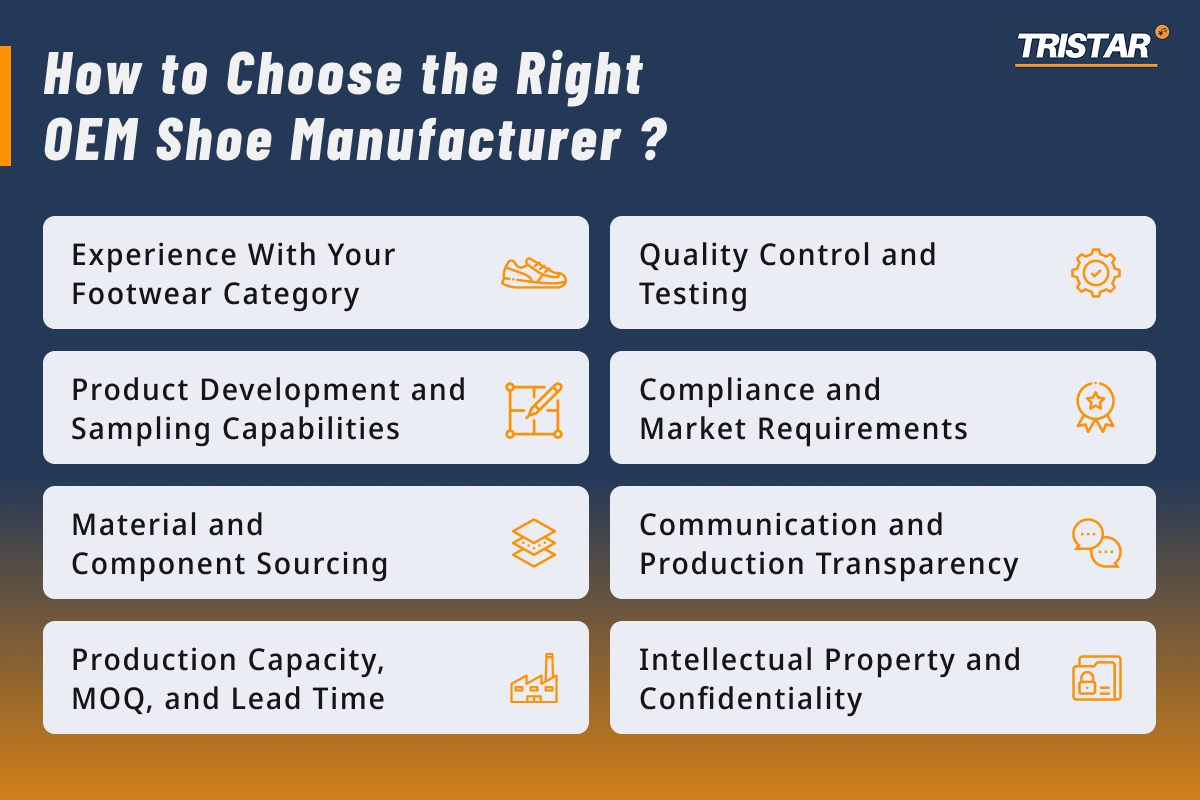
Choosing the right OEM shoe manufacturer is about more than finding the lowest quotation. A suitable partner should have the technical capabilities, production capacity, quality systems, and communication processes needed to turn your specifications into consistent finished footwear. Before placing an order, brands should evaluate the following areas carefully.
1. Experience With Your Footwear Category
Start by checking whether the manufacturer has experience producing the type of footwear you plan to sell. A factory specializing in leather dress shoes may use very different materials, machinery, construction methods, and testing procedures from one producing sneakers, sandals, work boots, or performance footwear.
Relevant experience can make product development smoother because the manufacturer is already familiar with the construction methods, common materials, and production challenges of that category. Flexibility for customization is equally important, especially if your brand requires unique designs, materials, colors, construction methods, or branding details.
2. Product Development and Sampling Capabilities
Sampling is one of the most important stages in OEM footwear production. The manufacturer should be able to interpret your tech pack, develop prototypes, identify potential production issues, and revise samples based on your feedback.
Look for a clear, structured sampling process that includes prototype development, sample evaluation, revisions, and final approval before bulk production. Pay attention to how accurately the supplier follows specifications and whether it can accommodate customization requests without compromising quality or production feasibility.
3. Material and Component Sourcing
Footwear production depends on many different components, including uppers, linings, midsoles, outsoles, insoles, laces, hardware, adhesives, and packaging. A strong OEM partner should have access to suppliers that can meet your required specifications, price targets, and production volumes.
Brands should also confirm whether specific materials can be consistently sourced for repeat orders, especially when developing long-term product lines. Transparent material sourcing, pricing, and supplier communication can help brands better manage costs, evaluate alternatives, and maintain consistent product quality.
4. Production Capacity, MOQ, and Lead Time
A manufacturer should be able to support both your current order requirements and your expected growth. Ask about minimum order quantities, monthly production capacity, development lead times, bulk production schedules, and peak-season availability before confirming the project.
The lowest MOQ is not always the best choice. What matters is whether the supplier’s production structure aligns with your order size and can maintain consistent delivery as volumes increase. A reliable partner should also provide transparent quotations, realistic production schedules, and regular progress updates so you can plan inventory and product launches with greater confidence.
5. Quality Control and Testing
Ask how the manufacturer controls quality throughout production rather than relying only on a final inspection. This may include incoming material checks, in-line inspections, approved sample references, workmanship standards, finished-product inspections, and footwear testing where required.
The appropriate tests depend on the shoe and its intended use, but may cover adhesion, flex resistance, abrasion, color fastness, and material performance.
Third-party audits and certifications, such as ISO 9001 and SMETA audits, are also important considerations. ISO 9001 focuses on quality management systems, while SMETA evaluates areas such as labor practices, health and safety, environmental practices, and business ethics. Buyers should verify the scope and validity of relevant certifications and audit reports rather than treating them as guarantees of product quality.
6. Compliance and Market Requirements
Different destination markets, retailers, and footwear categories may have their own requirements for materials, chemical substances, labeling, product safety, social compliance, or testing. Before production begins, confirm that the manufacturer understands the requirements relevant to your target market and can provide the necessary documentation or coordinate appropriate testing when needed.
For example, footwear sold in the European Union must meet EU footwear labeling requirements. Labels must identify the materials used in the three main parts of the shoe: the upper, lining and sock, and outer sole, using specified material categories and pictograms or written descriptions. A manufacturer supplying the EU market should therefore be familiar with these requirements and able to provide accurate material information for compliant labeling.
Also, in the United States, imported footwear must generally comply with CBP country-of-origin marking requirements, displaying its manufacturing origin, such as “Made in Vietnam,” in a legible, conspicuous, and sufficiently permanent manner.
7. Communication and Production Transparency
Clear communication becomes especially important when the brand and factory operate in different countries. A reliable OEM shoe manufacturer should provide timely updates on sampling, material sourcing, production progress, inspections, and potential delays rather than waiting until problems affect the delivery schedule.
Transparency should extend to production schedules, costs, factory information, and inspection reports, allowing brands to maintain visibility throughout the manufacturing process. Buyers should also understand whether key production stages are completed in-house or subcontracted to other facilities, particularly when consistency and traceability are important.
8. Intellectual Property and Confidentiality
If your footwear includes proprietary designs, custom molds, logos, patterns, or other brand assets, protecting your intellectual property should be a priority from the beginning.
Choose a manufacturer willing to sign a non-disclosure agreement (NDA) before receiving confidential designs or technical documents. The agreement should clearly define how your intellectual property, branding, tooling, and product specifications may be used, shared, and stored.
For additional protection, brands should also discuss contractual commitments preventing the manufacturer from producing directly competing products for other clients during the agreed period. These measures can help protect original designs, reduce the risk of unauthorized duplication, and establish greater confidence in long-term manufacturing partnerships.
Find the Right Shoe OEM Manufacturer With TRISTAR, Your Reliable Footwear Sourcing Agent
Ultimately, the right OEM shoe manufacturer should do more than simply make shoes. It should understand your specifications, manage production reliably, protect your designs, maintain agreed quality standards, and communicate clearly throughout the project. For brands sourcing overseas, working with an experienced footwear sourcing agent can make it easier to evaluate factories, coordinate development, monitor production, and maintain quality from sampling through shipment.
Founded in 1987, TRISTAR brings more than 35 years of manufacturing and sourcing experience to footwear projects. With development centers in China and Vietnam, we provide one-stop support across design, sampling, production, quality control, and logistics. TRISTAR is ISO 9001 certified and SMETA audited, with a focus on ESG and ethical sourcing, and signs NDAs to help protect clients’ designs. Its transparent collaboration approach, “Sourcing you can see through,” supports brands throughout each stage of production. Today, we work with over 30 partner brands and ships to more than 50 countries.
Planning a new footwear line or looking for a more reliable OEM setup? Book an online consultation with TRISTAR to discuss your product requirements and sourcing needs.
FAQs
Are OEM shoes fake?
No. OEM shoes are not inherently fake. OEM simply means that a third-party manufacturer produces footwear according to requirements established or approved by another company. When production and use of the brand’s intellectual property are properly authorized, the shoes can be legitimate branded products. Unauthorized copies or counterfeit products are a separate issue.
How can I tell whether shoes are genuine OEM products?
You usually cannot confirm authenticity simply by looking at the shoes. For branded footwear, check authorized sellers, purchase documentation, packaging, and brand authentication methods. For brands evaluating manufacturers, review production agreements, approved samples, and traceability records. ISO 9001 certification and SMETA audits can help assess supplier practices, but they do not establish product authenticity.
What should brands avoid when working with an OEM shoe manufacturer?
Avoid choosing manufacturers based solely on low prices, accepting unclear production schedules, or starting bulk production without approved samples. Brands should also clarify ownership of designs, patterns, and molds, establish quality checkpoints, and sign confidentiality agreements. Limited production transparency, inconsistent communication, and unwillingness to provide inspection reports are additional warning signs.
Are OEM shoes the same quality as branded shoes?
They can be. In fact, many branded shoes are themselves produced through OEM arrangements. Quality depends on the materials, specifications, construction, testing requirements, workmanship, and production standards set for each project. Therefore, “OEM” alone does not indicate whether a shoe is premium, budget, or somewhere in between.
Do OEM and ODM mean the same for footwear?
No. With OEM footwear, the brand generally controls the design and product specifications, while the manufacturer handles production. With ODM footwear, the manufacturer typically contributes more of the existing product design or development platform, which the brand can then select and customize. The exact division of responsibilities can vary between suppliers.
Where are most of the OEM shoes made?
Asia is a major global footwear manufacturing region, with key production hubs including China, Vietnam, Indonesia, Cambodia, and Bangladesh. Each country offers different strengths in production capacity, materials, labor costs, and supply chains. TRISTAR supports international footwear brands through its development centers in China and Vietnam, helping coordinate product development, sourcing, and manufacturing.